Flash Folk
The original format.
Flash Folk is a pop-up singing collective where we sing old songs of land, labour and resistance
Songs are taught by ear, explored together and sung by whoever is in the room.
Flash Folk is a pop-up singing collective where we sing old songs of land, labour and resistance
Music of the British Isles and beyond
No audition. No singing experience. No need to read music. No fixed membership.
We learn songs by ear, explore where they came from and sing them together.
Come once. Come again. Come knowing every word. Come convinced you cannot sing.
Medieval songs for the many
One rehearsal. One performance. Whoever turns up is the choir.
Friday 2 October 2026
Staffordshire St, Peckham
6pm to 10pm
Tickets from £5, matched £1 for £1
Coming alone? Good. We send you the songs beforehand.
Listen, learn what you can, then everyone comes together for one rehearsal before performing the songs that night as part of Staffordshire St's Festival of Community.
No auditions. No permanent members. No term of rehearsals.
A group comes together for one night, sings, performs, then disappears again.
Flash Folk is interested not only in preserving old songs, but in who sang them, why they sang them, how they changed and what happens when we sing them now.
Traditional songs were made to be sung.
Flash Folk brings them back into rooms full of people.
We teach songs by ear, talk about where they came from and give enough context to understand what we are singing before we sing them together.
You do not need to call yourself a singer.
You do not need to know folk music.
You do not need to have done anything like this before.
The repertoire moves through work, land, migration, protest, gender, love, drinking, leaving, returning and resistance.
Some songs have survived for hundreds of years. Others have travelled between places, communities and generations, changing as people carried them.
That movement is part of the tradition.
A group comes together and learns songs by ear.
We introduce each song, give some of its history and teach it piece by piece until the room is singing it together.
There are no auditions and no expectation that anyone arrives knowing the repertoire.
Most workshops teach everything in the room.
Some formats work differently. For a performance project, recordings and lyrics might be shared beforehand so everyone arrives ready to rehearse and build the songs together.
There can be harmonies, different versions, discussions about the words and moments where we stop to look at what a song is actually saying.
But Flash Folk is not a history lecture followed by a singalong.
The history and the singing belong together.
Music of the British Isles and beyond
The repertoire changes every time.
It can include work songs, ballads, drinking songs, sea songs, protest songs, songs of migration, women's songs, queer readings of traditional ballads and songs that people have been rewriting and arguing about for generations.
We are particularly interested in songs connected to land, labour and resistance, and in parts of folk history that are easily flattened or forgotten.
Workers. Women. Migration. Colonial exchange. Dissent. Gender. Queer readings. Sailors. Deserters. Poverty. Drinking. Sex. Leaving home. Coming back.
Some songs are medieval.
Some are much more recent.
Some cannot be neatly contained within one national tradition because the people who sang them were moving too.
Flash Folk can explore different parts of the repertoire, history or place.
The original format.
Flash Folk is a pop-up singing collective where we sing old songs of land, labour and resistance
Songs are taught by ear, explored together and sung by whoever is in the room.
Traditional songs explored through gender, sexuality, changed words, hidden histories and queer interpretation.
Folk songs are full of people crossing boundaries, taking on different identities, refusing expected roles and changing the words they inherited.
This strand gives those parts of the tradition room to breathe.
A collaborative strand exploring songs, rhythms and musical exchange moving between Britain, Africa, the Caribbean and the Americas.
Rather than treating British folk music as culturally sealed, the session looks at movement, exchange, maritime histories and the people whose music travelled with them.
This work is developed collaboratively with people whose musical, cultural and historical knowledge belongs in the room.
A place-based strand exploring music carried into London, made in London and changed by the people who have made the city home.
Songs become a way into migration, memory, neighbourhood and the histories living inside a city.
Flash Folk can work as a participatory workshop, a temporary singing collective, a performance project or a longer programme.
The format can change depending on the people, place and programme.
A single participatory folk-singing workshop. People learn a selection of songs by ear, hear the histories around them and sing them together. This works well for festivals, public programmes, libraries, museums, community events, arts venues and neighbourhood gatherings.
Participants receive the songs beforehand and learn what they can. Everyone then meets for one rehearsal before performing together as a temporary Flash Folk collective. The group exists for that event.
A participatory workshop that becomes part of the wider programme. The group learns songs together first and then shares some of them publicly. It keeps the openness of Flash Folk without turning into a conventional fixed choir.
A session built around a particular history, place, community or part of the repertoire. This could use one of the existing Flash Folk strands or be developed with you around the context of your programme.
A series of sessions gives people more time with the repertoire. The group can build a shared body of songs, explore their histories in more depth and gradually become confident carrying the material themselves.
Sessions are usually capped at 30 singers.
Flash Folk does not need a formal rehearsal room.
It can happen in a pub, festival field, library, museum, garden, community hall, university, arts venue or neighbourhood space.
It can sit inside festivals, community programmes, heritage programmes, council activity, university programmes, older people's programmes, housing and resident projects, public events and cultural programmes.
You do not need to know exactly which format you want before getting in touch.
Tell us where it is happening, who you want to bring together and what you are trying to make.
We can build the right session around that.
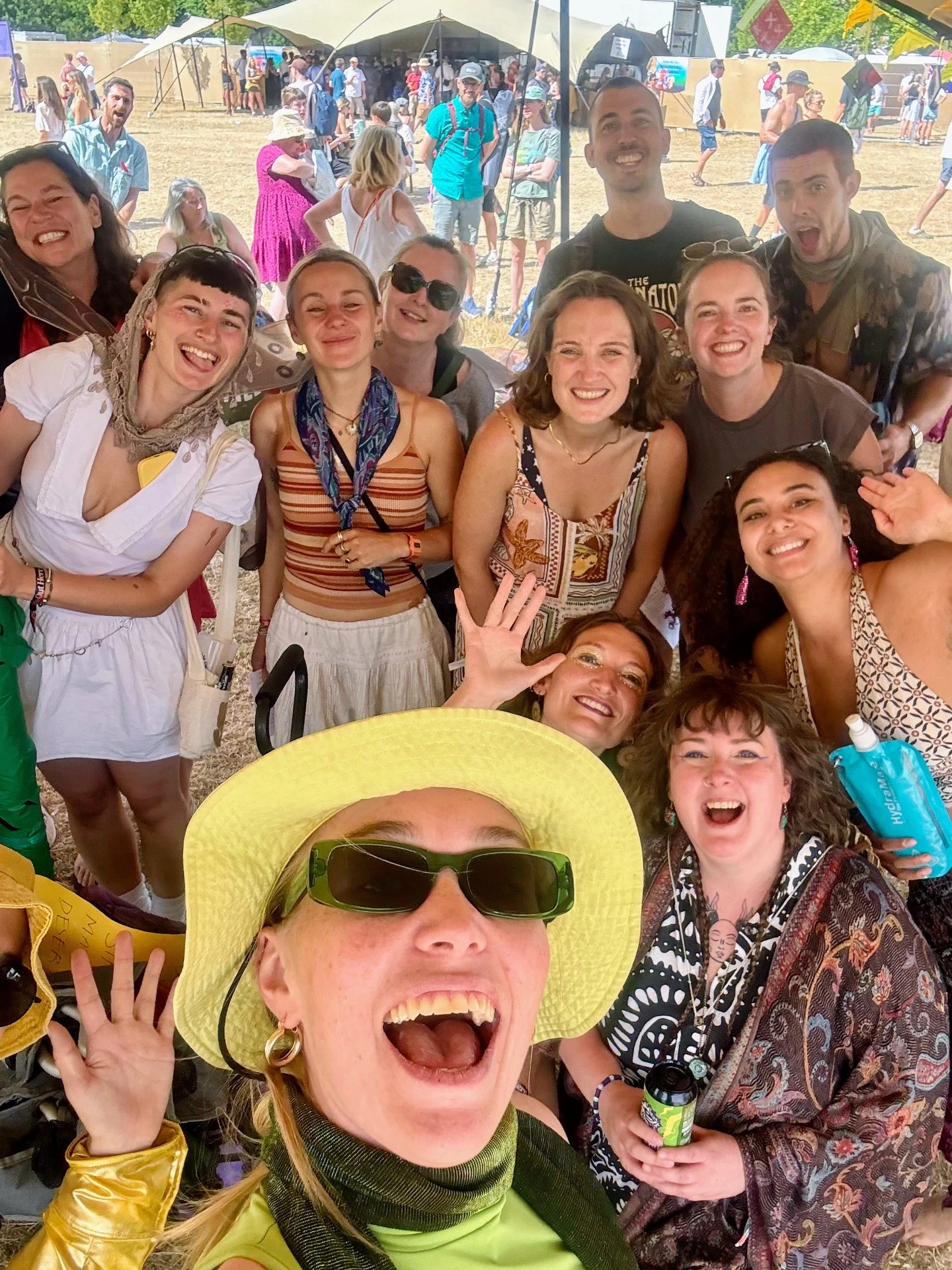
Flash Folk has already happened in festival fields, cultural venues, gardens and community spaces.
No.
No.
No. Everything is taught by ear, piece by piece.
Yes.
No. Flash Folk is pop-up, so you can come to the sessions that work for you.
You can still come.
Not in the usual sense.
Flash Folk is a pop-up singing collective where we sing old songs of land, labour and resistance
There are no permanent members, auditions or fixed membership.
Some projects become temporary performance groups, but many sessions simply exist for the people singing in the room.
Music of the British Isles and beyond
The repertoire includes traditional songs from England, Ireland, Scotland and Wales, alongside music shaped by migration, movement and musical exchange beyond the British Isles.
Yes, alongside later traditional songs and ballads.
Medieval songs for the many
We are interested in making very old music feel usable rather than distant.
Sometimes.
Traditional songs have always changed as people sing them.
We might compare different versions, return to an older lyric, change a word, explore how a song travelled or look at it through a contemporary feminist or queer lens.
Our own public Flash Folk sessions are pay what you can wherever possible.
Nobody should be excluded because they cannot afford a ticket.
Yes.
Festivals, venues, libraries, museums, councils, community organisations, universities and other cultural or public programmes can commission a workshop, themed session, temporary performance project or longer programme.
A Flash Folk project can last an hour, fill an evening, become part of a festival or develop over a series of sessions.
Tell us where it is happening, who might be there and what you want the project to do.